At a glance:
- MetLife Stadium is in the news because a World Cup match is expected to affect weekday travel in the New York-New Jersey region.
- ABC7 New York reports that officials are warning of traffic restrictions and street closures that could slow Tuesday’s commute.
- NBC New York says the first weekday World Cup match in the area may be especially difficult for NJ Transit riders.
- The New York Times recently compared several ways to reach the stadium from Midtown Manhattan, underscoring how many travel variables are in play.
MetLife Stadium is drawing search interest for a straightforward reason: it is the site of a World Cup match, and the match is landing on a weekday when millions of people are also trying to move around the New York-New Jersey region for ordinary workday reasons. The reporting in the source packet does not suggest a mystery around the venue itself. It points instead to a familiar kind of urban problem: a major event, a dense transit network, and a travel day that may be harder than usual.
That is why the headlines are not just about soccer. They are also about roads, rail service, and the practical question of how a crowd heading to one stadium affects everyone else using the same transportation system.
What the reporting says is happening
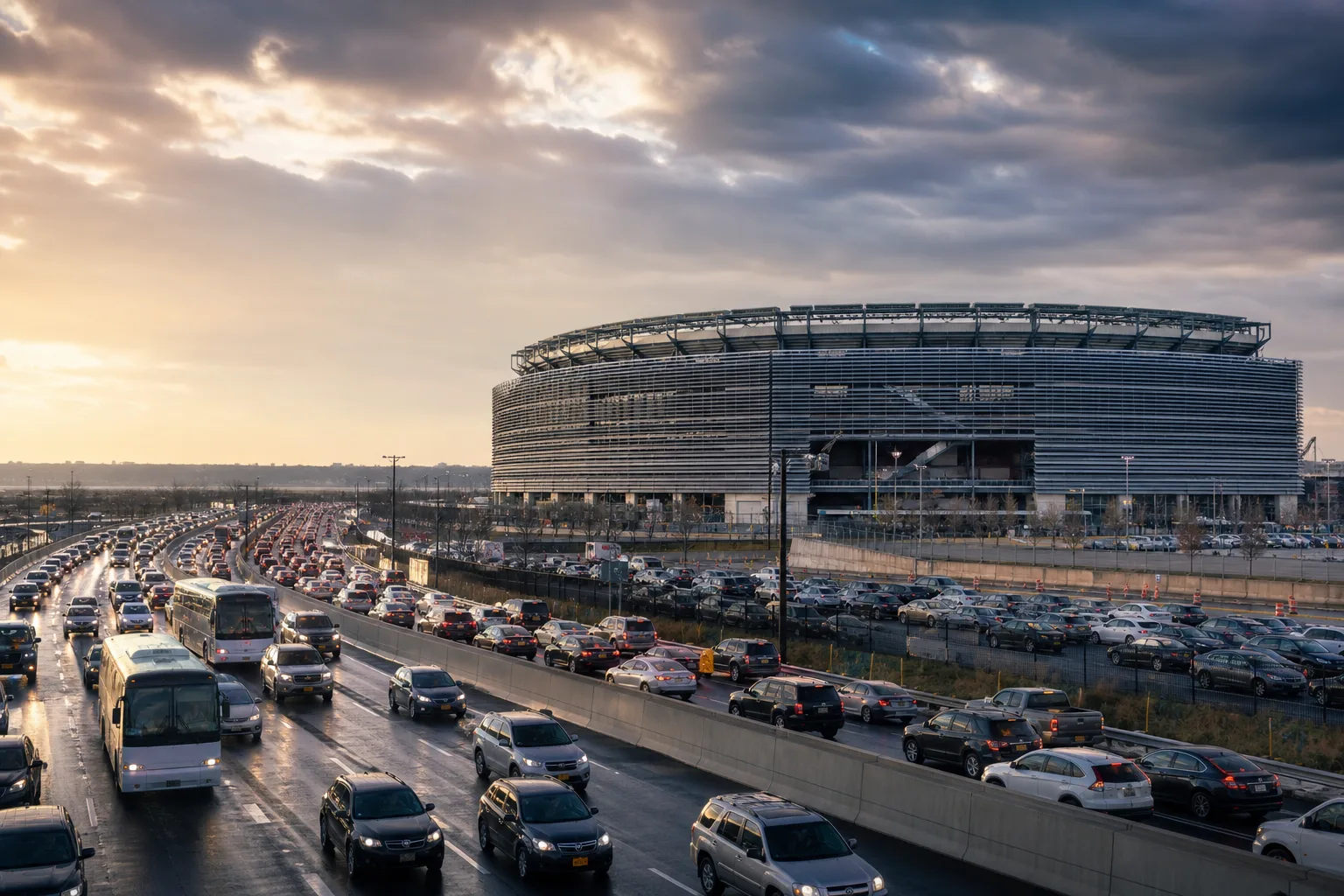
ABC7 New York reports that city officials are urging commuters to plan ahead because traffic restrictions and street closures could snarl Tuesday’s commute as thousands of fans travel to MetLife Stadium. NBC New York adds that the first weekday World Cup match in the NY/NJ area could create a “nightmare commute” and identifies NJ Transit commuters as potentially the most affected group.
Those are the central facts supported by the packet. The concern is not simply that a stadium will be busy. It is that the event is expected to overlap with a weekday commute, when roads and transit lines are already carrying regular traffic. That overlap is what makes the situation noteworthy.
The packet also includes a New York Times video in which reporters raced from Midtown Manhattan to the first World Cup game at MetLife Stadium using bus, train, bike, or Uber. The video format is relevant because it frames the trip as a comparison of time, access, and convenience rather than as a single fixed route. The source packet does not provide the outcome of that race, so any claim about which mode “wins” would go beyond the evidence provided.
Why a stadium event affects more than attendees
When a large event takes place on a weekday, the impact reaches beyond the fans who bought tickets. The stadium may be the destination, but the roads and transit lines leading there are shared with daily commuters, delivery traffic, and other routine trips. That is especially true in the New York-New Jersey area, where multiple transportation systems converge and delays in one part of the network can spread elsewhere.
The source packet suggests that this broader ripple effect is the real concern. ABC7’s mention of traffic restrictions and street closures indicates that normal driving patterns around the stadium area may not apply. NBC New York’s focus on NJ Transit points to another layer of disruption: rail riders may be affected even if they are not going to the match. The New York Times video reinforces the same point from a different angle by treating the route to the stadium as a transportation puzzle with several possible answers.
For readers who are only seeing the search term “MetLife Stadium,” that context matters. The venue is not trending because of a new building project, a celebrity appearance, or a change inside the stadium. It is trending because it has become the center of a regional travel warning tied to an event with a large and time-sensitive arrival pattern.
What is confirmed, and what is not
The source packet supports several specific claims:
- Officials are warning commuters to plan ahead. ABC7 states that explicitly.
- Traffic restrictions and street closures are expected. ABC7 reports those measures could affect Tuesday’s commute.
- NJ Transit riders may face the most disruption. NBC New York says they may be the most impacted.
- The issue involves the first weekday World Cup match in the NY/NJ area. That timing is highlighted by NBC New York.
- Travel to the stadium is being examined through multiple modes. The New York Times video compares bus, train, bike, and Uber from Midtown Manhattan.
What the packet does not provide is just as important. It does not include a full list of road closures, specific detour maps, transit service changes, exact travel times, or a complete event operations plan. It also does not say how severe delays will be for every traveler. Any article that presents those details as known facts would be adding information not found in the sources.
So the most accurate way to summarize the situation is this: there is a credible, officially acknowledged concern about disruption, but the exact scale of that disruption is not spelled out in the source packet.
Why weekday timing changes the stakes
A stadium event on a weekend is one thing. A stadium event on a weekday is another. Weekday travel creates a different set of pressures because it coincides with work schedules, school drop-offs, medical appointments, and other ordinary obligations. In the New York-New Jersey region, those obligations are often tightly linked to transit timetables and road capacity.
That is the logic behind the warnings in the reporting. The issue is not just that fans need to get to MetLife Stadium; it is that they are expected to arrive at the same time that regular commuters are trying to move through the same area. Even without knowing the exact closures, it is easy to see why officials would highlight planning ahead as the central message.
NBC New York’s framing is useful here. By calling the match a possible “nightmare commute,” the outlet is signaling the kind of stress that can arise when a major event lands in the middle of the workweek. The wording is clearly attributed to the broadcaster, but the underlying point is broader: the commute problem is part of the story, not a side effect.
What the transportation comparison tells readers
The New York Times video adds texture to the story by comparing bus, train, bike, and Uber as ways to reach MetLife Stadium from Midtown Manhattan. That kind of comparison does not settle the question of the best route, but it does show how many variables are involved in a trip like this: traffic, station access, transfer time, and the unpredictability that comes with a major event day.
Because the packet does not publish the results of the race, the comparison should be understood as a reporting device rather than a conclusion. Its value lies in demonstrating that there is no single obvious answer for everyone. A route that seems efficient in normal conditions may be less dependable when traffic restrictions are in place or when transit volumes rise sharply.
This also explains why interest in MetLife Stadium can spike even among people who are not attending the match. If the trip is unusual enough to prompt a time trial between transport modes, it becomes news for anyone who depends on the same network of roads and rail lines.
How to read the current search interest
If you are seeing MetLife Stadium surface in search or social feeds, the simplest explanation is transportation, not spectacle. The stadium is relevant because it is attached to a specific World Cup match and because that match is expected to affect commuting patterns across the region.
There is also a second layer to the search interest: people want to know whether the travel situation will affect them even if they are nowhere near the stadium. The packet suggests that the answer may be yes, at least for some commuters, but it stops short of mapping the full area of impact. That is why the most responsible summary avoids exaggeration. The concern is real, but the precise extent remains undefined in the material provided.
In practical reporting terms, the story is about a venue becoming a transit reference point. MetLife Stadium matters here because it is the anchor for a day when roads, trains, and streets may all be under pressure at once.
Bottom line
MetLife Stadium is drawing attention because a World Cup match there is expected to collide with a weekday commute in the New York-New Jersey region. ABC7 New York reports that officials are urging commuters to plan ahead as traffic restrictions and street closures could slow travel. NBC New York says NJ Transit riders may be especially affected by what it describes as the first weekday World Cup match in the area. The New York Times, meanwhile, shows that getting to the stadium can involve several different modes of transportation, each with its own tradeoffs.
The clearest takeaway is also the least flashy: the stadium is part of a regional transportation issue, and the timing of the match is what makes the commute warning newsworthy.